Information Is Power. Knowledge Is a Responsibility.
From my earliest professional years in the media, I heard a phrase that has never left me: information is power. And I have always believed it.
I have devoured newspapers, magazines, and publications of every kind. I have felt an almost insatiable curiosity to understand what was happening around me, why it was happening, and, above all, why so many things that could have been done extraordinarily well ended up being done in a mediocre way.
Over time, I came to understand something even more important: information allows you to understand the world, but knowledge allows you to transform it.
And when that knowledge is placed at the service of something you deeply love, it stops being merely a professional tool and becomes a personal responsibility.
In my case, that something is Spain. And, very especially, its gastronomy.
Loving Spanish Gastronomy Means Much More Than Enjoying It
Few cultural expressions have the power to create as much happiness as gastronomy.
An exceptional Ibérico ham, an outstanding extra virgin olive oil, artisan Cantabrian anchovies, a patiently crafted cheese, or a wine that expresses the personality of its terroir can turn a gathering into an unforgettable memory.
But gastronomy is much more than pleasure. It is history, identity, landscape, knowledge, tradition, and the transmission of values.
My personal and professional journey, always connected with people from different cultures and nationalities, has allowed me to witness something fascinating: when you explain a Spanish product properly, you are not simply presenting food. You are representing a culture.
And that changes the conversation completely.
I have experienced that moment many times when an international contact begins by listening to a commercial presentation and ends up discovering a story they never knew.
The transformation is extraordinary. Suddenly, price is no longer the central issue. Respect, curiosity, and admiration take its place.
Because when knowledge is accompanied by the tasting of an exceptional product, words take on another dimension. It is almost poetry.
It is an expression of our culture that, allowing for the differences, reminds me of the ability of our great writers to turn words into emotion.
But it would be a mistake to settle for simply inspiring admiration. That emotion must also translate into recognition, international positioning, and economic value for our businesses.
Spain Has an Extraordinary Problem: We Still Haven't Told the Story of Our Excellence Well Enough
This is something I have thought about many times. What a fortunate problem to have!
We have extraordinary raw materials, exceptional producers, centuries-old traditions, unique territories, and a gastronomic diversity that few countries can match.
And yet, we still need to explain much better to the world who we are.
Not because we lack quality, but because quality that remains unknown can hardly be appreciated in its full dimension.
For too long, we have assumed that having a good product was enough.
It isn't.
Excellence must be identified, documented, explained, defended, and communicated.
And we must learn to distinguish it rigorously from conventional quality, without looking down on anyone, but without accepting that everything can be presented as extraordinary.
Not all olive oils are the same. Not all Ibérico hams offer the same experience. Not all artisan preserves follow the same production methods.
And not every product with an attractive label necessarily represents the level of excellence that Spanish gastronomy deserves.
Our duty is to explain those differences.
With knowledge, transparency, and confidence.
Because the future of Spain's gourmet reputation will not be built solely by producing better products. It will be built by helping the world understand why we are better when we truly are.
Those Who Do Not Control Their Own Story End Up Negotiating Someone Else's
There is a business reality that far too many producers know well.
You can create a magnificent product, spend years perfecting your processes, and take care of every detail of its presentation.
But if the market does not know your brand, understand what makes you different, or know why it should choose you, you end up depending on third parties to reach consumers.
Distributors play a fundamental role. Good distributors are indispensable allies.
But when a brand completely delegates its visibility, positioning, and communication, it also risks delegating its value.
And that is when the most dangerous negotiation begins: the one that reduces an entire story of excellence to a price comparison.
“I have another similar product that's cheaper.”
How many times have we heard that?
The problem is not always that a less expensive alternative exists.
The problem is that the buyer may not have enough information to distinguish what they are actually comparing.
If customers do not understand your excellence, they can hardly demand it.
That is why I believe original, high-quality, authoritative content has become one of the most important strategic assets for any gourmet producer.
I am not talking about publishing attractive photographs or repeating advertising slogans.
I am talking about building knowledge.
Explaining varieties, breeds, territories, production methods, raw materials, ageing processes, tasting notes, culinary applications, and quality criteria.
I am talking about educating the market so that people learn to appreciate what they previously could not distinguish.
And, above all, I am talking about taking back control of our own story.
Made in Spain Gourmet: From a Commercial Platform to a Source of Expertise
When we launched Made in Spain Gourmet, our ambition was never limited to selling Spanish products online.
We wanted to build something deeper.
A platform capable of connecting Spanish gastronomic excellence with consumers, professionals, businesses, and international markets.
Over time, that vision has evolved.
Today, I understand more clearly than ever that our true value lies not only in the products we select, but in the knowledge we can share about them.
When we advise a European customer on which Ibérico ham to choose, which olive oil to use for a particular dish, or how to pair certain seafood preserves with a Spanish wine, we stop acting as simple sellers.
We become gastronomic advisors.
And that transformation is decisive.
An advisor does not simply offer a catalog. An advisor listens, interprets, compares, recommends, and helps people make better decisions.
And, of course, builds trust.
Trust, in the premium market, is an asset of enormous value.
Our content has enabled us to connect with people from different cultures who share the same appreciation for enjoying life through gastronomy.
People who may not speak our language but who perfectly understand the universal language of an exceptional product.
That is the true international reach of Made in Spain Gourmet.
Consumers Are Changing. Brands Must Change With Them.
There is another transformation I observe with great interest.
Gourmet consumers are becoming increasingly curious, informed, and demanding.
They are no longer necessarily satisfied with a photograph, a well-known brand, or a generic description.
They want to know more.
They ask about origins, ingredients, production methods, differences between categories, serving recommendations, and the reasons behind a product's price.
In our own experience using artificial intelligence tools for customer service, we encounter questions that demonstrate just how deeply consumers want to understand products.
And I find that exciting.
Because a consumer who asks questions is a consumer willing to learn.
And a consumer who learns can recognize excellence more effectively.
Artificial intelligence does not replace authentic knowledge. It amplifies it.
Provided that it is supported by rigorous information, real experience, and a genuine desire to help.
New technologies make it possible to organize, translate, and distribute content at a scale that would have been unimaginable for many businesses just a few years ago.
But no technology can legitimately invent a producer's history, replace their experience, or manufacture the authenticity of a region.
Technology accelerates. Knowledge differentiates. Trust converts.
That combination can change the international future of our gastronomy.
Excellence Also Needs a Commercial Strategy
We cannot remain trapped in romanticism.
Defending Spanish gastronomy also means helping our companies become more competitive, profitable, and recognized.
Excellence must translate into better business opportunities.
To achieve that, we need to integrate three dimensions that are too often addressed separately: culture, communication, and commercialization.
Culture explains who we are.
Communication ensures that people discover and understand us.
Commercialization transforms that interest into sustainable economic relationships.
And we must add a fourth decisive dimension: technology.
E-commerce, international distribution, professional sales channels, and digital tools allow consumers in Vienna, Paris, Berlin, or any other European city to access Spanish products they might otherwise struggle to find locally.
Physical distance should no longer mean gastronomic distance.
But to take advantage of this opportunity, we must stop thinking exclusively about selling individual units.
We must think about building markets.
And high-value markets are built through positioning, differentiation, consistency, and credibility.
Producers and Institutions: Investing in Knowledge Is Not an Expense
Here, I want to share a reflection specifically with Spanish brands and their leaders.
Are we really investing enough in explaining our excellence?
My impression, after years of conversations and commercial experience, is that we still have a long way to go.
Many producers make extraordinary efforts to improve facilities, select raw materials, perfect production methods, or develop new formats.
And all of that is essential.
But how much of their budget do they devote to documenting their expertise, building their own narrative, and presenting it internationally?
How many are prepared to explain their differences in depth, in several languages, and on an ongoing basis?
How many understand that their story, told properly, can become a competitive advantage?
Knowledge should not be the last item in the marketing budget.
It should be part of a company's strategic assets.
We also need institutions capable of understanding this opportunity through a broad, long-term vision.
The international promotion of our gastronomy should not depend exclusively on occasional campaigns, trade fairs, or changing political priorities.
We need a national strategy.
A strategy that supports producers, connects culture and commerce, and promotes Spanish excellence with international ambition.
And if institutions do not move quickly enough, businesses must assume our share of responsibility.
Because waiting indefinitely is not a strategy either.
Spain Does Not Need Permission to Compete With France or Italy
I deeply admire the ability of France and Italy to turn their gastronomic heritage into international prestige.
They have learned how to build recognizable narratives, associate products with their regions, and transform certain traditions into symbols of value.
We have much to learn from their ability to communicate and position themselves.
But learning does not mean accepting an inferior position.
Spain has its own solid and extraordinary strengths to compete in the most demanding markets.
We do not need to imitate anyone else's gastronomic identity.
We need to understand our own identity better, explain it with greater ambition, and defend it with stronger conviction.
Our cultural and historical heritage, with both its achievements and its shortcomings, is part of a complex identity that deserves to be understood with rigor.
And our gastronomy offers a magnificent opportunity to showcase the best of that identity: creativity, diversity, tradition, hospitality, and an extraordinary relationship with food.
This is not about proclaiming that we are superior.
It is about ensuring that our excellence is recognized on its own merits.
That requires self-confidence, but also work.
Pride, but also knowledge.
Ambition, but also perseverance.
The Future of Gourmet Spain Is Being Written Today
The conversations I have with professionals, customers, producers, and lovers of Spanish gastronomy across different European countries reinforce my conviction every day.
There is a market ready to recognize and appreciate our excellence.
There is curiosity. There is demand.
And there is an international community eager to discover Spain through its finest products.
What we need is to connect all these elements with greater intelligence and determination.
Create original content.
Share knowledge.
Educate consumers.
Support producers.
Build long-term commercial relationships and use technology without losing our authenticity.
Understand, once and for all, that every time we help someone appreciate the value of an outstanding Spanish product, we increase the value of our entire gastronomy.
This is not a task reserved for one company, institution, or brand.
It is a collective opportunity.
At Made in Spain Gourmet, we have decided to do our part.
We want to continue learning, communicating, advising, and connecting Spanish excellence with the world.
Because I am convinced that the next great international breakthrough for our gastronomy will not depend solely on what we produce.
It will depend on our ability to ensure that the world knows, understands, desires, and values what we produce.
Information is power. Knowledge creates authority. Authority builds trust. And trust, when grounded in genuine excellence, opens markets and creates the future.
Spain has so much to tell.
And the time has come for us to write our own story.
To all the producers, professionals, brands, and gastronomy lovers who share this vision, I invite you to help build a stronger, more widely recognized, and more international Gourmet Spain.
Not tomorrow. Today.
I'm here, ready to work with you.
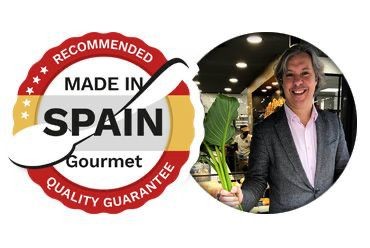
Israel Romero Delcán CEO & Founder