How to choose authentic Iberian ham
There is a scene that repeats too often: someone pays a premium price for a ham that promises excellence and, when they open it, finds a correct piece, yes, but without the aromatic depth, the glossy fat or the elegance that define true Iberian. If you wonder how to choose authentic Iberian ham, it’s useful to start with a very simple idea: not everything that looks Iberian deserves that name in the most demanding gastronomic sense.
The highest-quality Iberian ham is not bought by intuition or an eye-catching label alone. You choose it by understanding what’s behind the piece: breed, feeding, curing time, origin and presentation. In a product so emblematic of Spanish gastronomy, detail makes the difference between an acceptable purchase and a memorable experience.
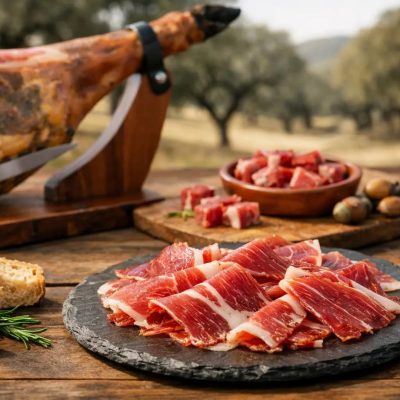
How to choose authentic Iberian ham without being impressed by the packaging
The first filter is the breed. To properly call a ham "Iberian," the animal must come from the Iberian breed in the percentage required by regulation. Here one of the first common confusions appears: a ham can be Iberian and still not offer the sensory level many consumers expect when looking for an exceptional piece.
That’s why it’s not enough to
read “ibérico” in large letters. You must check the breed percentage. 100% Iberian usually represents the purest and most prestigious expression of the product, with very recognizable fat infiltration and aromatic complexity. 50% or 75% Iberian can produce great results, but you need to look more closely at the other factors. It’s not about dismissing one category in favor of another, but knowing what you’re buying and whether the price truly reflects the gastronomic value.
Feeding is the second major criterion. This is where an essential part of the ham’s character is decided. An acorn-fed Iberian does not taste the same as a grain-fed (cebo) or field-fed (cebo de campo) one. Bellota (acorn-fed) comes from animals raised in the dehesa and fed during the montanera (the acorn-feeding season) on acorns and natural resources. That translates into more fluid fat, more complex aromas and a much longer persistence on the palate. It is, with reason, the most admired category in Spain and one of the pinnacles of the global gourmet charcuterie scene.
Field-fed (cebo de campo) can be an excellent option if the producer manages breeding and curing well. It has a less deep profile than bellota, but can offer balance, juiciness and nobility. Grain-fed (cebo), meanwhile, corresponds to another positioning. It can be appropriate for daily consumption, but you shouldn’t pay for it as if it were a great dehesa ham.
Labels and seals: the key to choosing authentic Iberian ham
If there is one gesture that separates the informed buyer from the one who buys blindly, it is to look at the seal. In Spain, the Iberian standard uses a color system that helps identify the commercial category quickly.
The black seal corresponds to 100% acorn-fed Iberian. It is the most exclusive reference and the one that concentrates the greatest prestige. Red indicates acorn-fed Iberian, but not necessarily 100% Iberian breed. Green identifies field-fed Iberian (cebo de campo) and white, grain-fed Iberian (cebo).
This code is useful, although it should not be the only criterion. Two hams with the same color can offer very different results. The reason is simple: final quality also depends on livestock management, curing, finishing and the seriousness of the producer. In a premium product, traceability is not a commercial ornament. It is a guarantee of authenticity.
Therefore, look for clear information about the curing cellar, the production area and the producer. When a brand explains the origin of its pieces, the curing time and the product profile well, it conveys something decisive: trust. And in gourmet purchases, trust is worth as much as flavor.
What signs a good piece reveals before tasting it
An authentic Iberian ham can also be recognized by sight. The shape of the piece is usually slender, with a narrow shank and an elegant silhouette. The hoof can give clues, although it is not absolute proof. For years it has been repeated that a “black hoof” always equals excellent Iberian, but that is not so. It is a possible indication, not a certificate of quality.
What does matter a lot is the exterior fat. It should look glossy, not dry or dull. The color can range from off-white to yellowish tones. That fat, when it comes from good rearing and proper curing, is usually unctuous to the touch and heralds good internal infiltration.
When sliced, the color of the meat should move between intense reds and darker nuances, with fine veins of infiltrated fat. That marbling is one of the great signs of top-level Iberian. It not only beautifies the slice: it supports texture, aroma and that almost enveloping sensation that lingers on the palate.
Also be wary of pieces that are excessively dry, flat in color or with hard, waxy fat. These sometimes reveal unbalanced curing or raw material that wasn’t up to par. A premium ham should suggest delicacy even before the first bite.
Curing: where time becomes value
Few things distinguish a great ham as much as long, well-managed curing. Here the number of months doesn’t rule alone, although it matters. It also depends on how the piece has been finished, in what conditions and with what artisanal criteria.
Insufficient curing leaves an immature product, with underdeveloped aromas and a less elegant texture. Excessive curing can dry the piece and reduce its harmony. The perfect point depends on the size of the ham, its fat and the producer’s style. That “it depends” is not evasive: it is the essence of noble products.
As a general guideline, high-end pieces usually move within long curing periods, capable of developing notes of nuts, shrubland, aged butter and a fine saline depth, never aggressive. When a seller only highlights price and is silent about curing, an important part of the story is missing.
Whole leg, deboned or pre-sliced
The choice also changes depending on how you will consume the ham. The whole leg offers the most complete experience. It better preserves the product’s evolution, allows on-the-spot slicing and adds that ritual component so linked to Spanish culinary culture. It is the ideal option for those who consume it frequently, enjoy hosting guests or want a product with strong table presence.
The deboned format makes slicing and storage easier. It is practical, clean and highly appreciated by those who want quality without dealing with holding the leg. If the product is good, the experience remains excellent.
Pre-sliced, when well prepared, is a magnificent solution for many European households. It allows portion control, preserves freshness and lets you enjoy ham conveniently. Here, however, slicing matters enormously. A premium pre-sliced product must be thin, tidy and balanced in fat. A poor cut ruins part of an extraordinary piece’s potential.
Price: expensive doesn’t always mean better
In gourmet gastronomy, price guides but does not rule. An authentic and outstanding Iberian ham will never be cheap, because behind it are years of rearing, dehesa, selection and curing. However, there is also a lot of overpricing built on vague messages, luxurious packaging or terms used too liberally.
The useful question is not whether it costs a lot or a little, but whether the price fits the product’s real category. A 100% acorn-fed Iberian from a serious producer, with traceability and long curing, justifies a higher investment. A grain-fed Iberian presented as if it belonged to the same league does not justify it.
This is where a curated selection makes a real difference. A specialist who works only with premium Spanish gastronomy filters much of the market noise for you. And that, for someone buying from outside Spain or who wants to get it right the first time, has obvious value.
Common mistakes when buying Iberian ham
The most common is buying by the name without reading the full category. The second is being seduced by improbable offers. In an excellent product, extreme discounts often hide cuts in breed, feeding, curing or traceability.
Another common mistake is thinking all consumers need the same piece. It is not always necessary to go to the top of the range. If you want a ham for frequent snacks, a good field-fed Iberian (cebo de campo) can give you enormous satisfaction. If you want to gift an iconic reference or serve something truly memorable, 100% acorn-fed Iberian plays in another dimension.
It is also advisable to avoid impulse buying on notable dates, when rushed commercial messages and vague descriptions abound. Iberian ham deserves a more refined decision.
Choosing well is, ultimately, a form of respect for the product. When you get it right, you don’t just buy an exceptional food. You bring to your table one of Spain’s great expressions, with all its tradition, craftsmanship and that unmistakable pleasure that only truly authentic products offer.
AUTHOR: Israel Romero, CEO of Made in Spain Gourmet.